


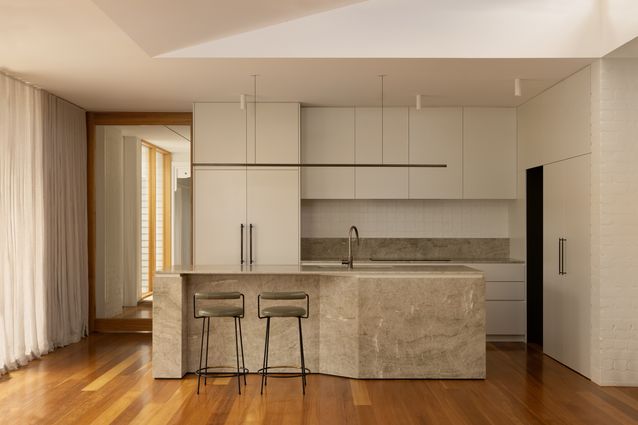
When it comes to houses, the notion that bigger is better is changing. The allure of the large, extravagant house doesn’t quite have the same appeal to it when you consider the growing inaccessibility of housing in Australia or the environmental implications that building big can have. While the statistic that Australian houses are the largest in the world may not fill us with much national pride, projects that embrace a “build less” approach stand out as beacons of hope in a society that often glorifies excess.
When architects design their own homes, they often have a unique opportunity to challenge conventional living standards and demonstrate the value of designing for needs rather than desires. Stuart Telha, a director at Tehla Clarke, took advantage of this opportunity when expanding his own family home, an almost century-old Californian bungalow. The project involved preserving the original bungalow in its near-entirety, removing an asbestos-laden rear lean-to and substituting it for a modest and contemporary pavilion.

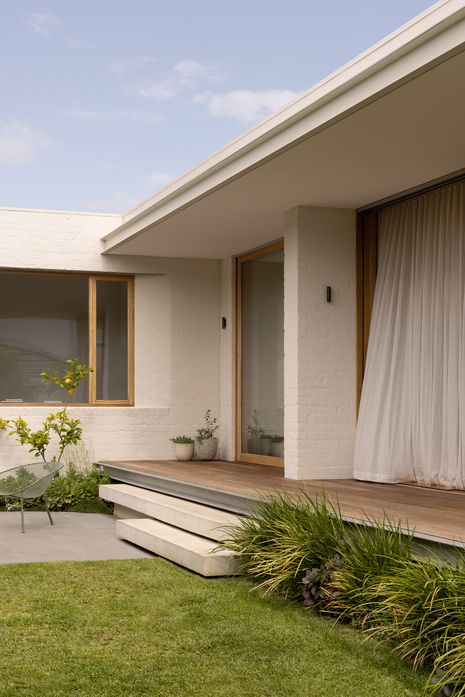
Taking cues from modernist design, the rear extension is elevated, creating the impression that the volume is floating above the garden. As a result, when you descend from the raised interior living spaces into the garden there is a sense of being enveloped by nature that has been created. The decision to raise the addition was driven by modernist aesthetics as well as the need to comply with a stormwater flood overlay. This has led to a gradual ascent as you venture further into the home from the front.
The addition respects and builds on the craftsmanship of the original volume without simply imitating it. Tehla befittingly described the intention behind this complementary integration as a “gentle connection” between the two volumes. A comparable shade of white is carried from the original timber facade onto the new brick exterior, demonstrating a reinterpretation of the existing colour palette through a fresh application of materials. A red brick barbeque area and fireplace mirror the red of the brick columns at the front entrance.
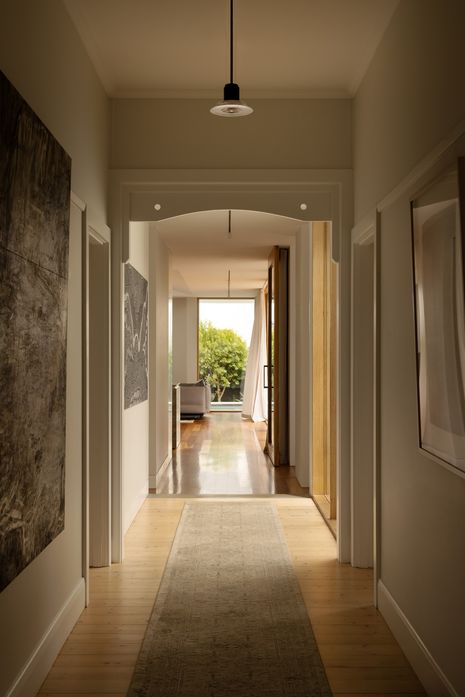
The project provided a chance to rework the existing home’s layout, allowing the bungalow to be reserved for the bedrooms while folding new living spaces into the extension. The original bathroom, kitchen and bedroom have all been converted into bedrooms, all without altering the footprint of those spaces. The move to separate the sleeping zone from the more active areas of the family has fostered a sense of privacy. A clear delineation between these zones is evident, marked by the shift in flooring materials and orientation – from the original Baltic pine laid across the corridor to the new blackbutt timber arranged lengthways along the addition. A concrete step acts as a buffer between old and new sections, while a new central courtyard opening to the north further emphasises the contrast.
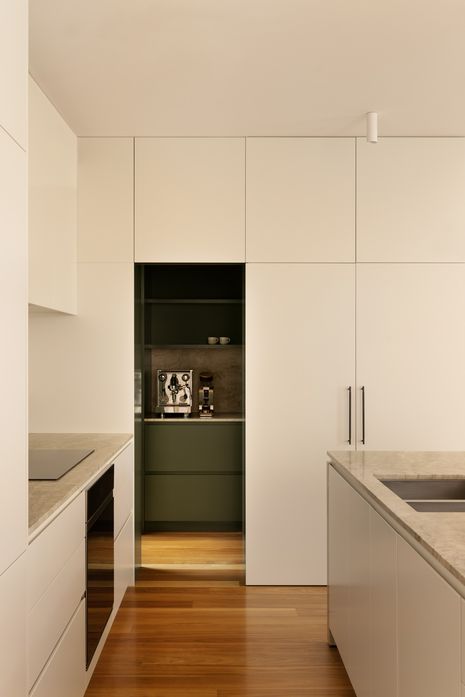
In the kitchen, attention is immediately drawn to a green walk-in pantry. A slender entrance invites you to explore this green area, but it’s only once you’re inside that the space completely unfolds. Originally, a door was planned to conceal the pantry as a hidden gem but that design choice was abandoned once the Tehla family observed the intrigue that was generated by leaving the space on show. At first glance, the colour of the pantry seems to sit in juxtaposition with the kitchen’s more understated palette of whites and greys. However, upon closer inspection, hints of green in the quartzite kitchen benches emerge, visually connecting the two spaces.
Skylights incorporated into the ceiling above the living spaces effectively address a need for natural light, which is limited by deep, exaggerated eaves on the northern aspect and the absence of south-facing windows due to the prioritisation of storage. A raked ceiling above these spaces adds dimension and depth to living spaces that might have otherwise appeared flat and confined.
In the living room, a concrete ledge cuts through the painted white brick on the fireplace and extends across the room. According to Telha, this unassuming ledge has proven to be unexpectedly multifunctional, serving as a seat, a display area for various items or a storage space for firewood underneath. Echoing this feature is an in-situ platform that interrupts the external brick fireplace, providing yet another casual spot for sitting.
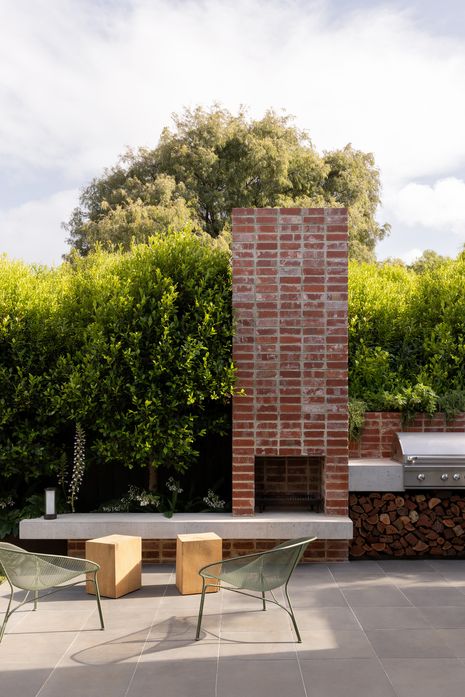
Grounded in a “less is more” philosophy, Tehla shared that their ambition for the house was to be as sensible as they could be when it came to environmental considerations. This philosophy is reflected in the the preservation of the original structure, the compact footprint of the addition and the minimal selection of materials. Prioritising waste and resource reduction, they incorporated recycled bricks into both the extension and its new exterior, as well as the newly designed courtyard.
At the heart of Ormond House is a desire to live a life free from excess, focusing on the capitalisation of external space rather than building big and losing the garden in the process.
link