
Theoretical foundations
Basic overview of evolutionary game theory
The basic idea of Evolutionary Game Theory30 is that there will be more than one (N ≥ 2) participants in the game system (i.e., the group), and under the assumption of finite rationality, people can not anticipate what kind of strategy will be chosen by the participants at the beginning of the game, and the participants of the game can not choose the optimal strategy in the first time of the game. But they can learn or imitate the behavior of other participants31, in the repeated process of the game constantly adjust and improve their own choice of strategy, and finally make the game system gradually stabilized in a certain equilibrium strategy, of course, this stabilization result is not static, when certain conditions change, the original homeostasis will also change.
Due to the research objectives of this study aligning with evolutionary game theory, it aims to explore how different energy consumption behaviors of subjects in university dormitories interact over time, and to explain the stable states that energy consumption behaviors will reach under various conditions, as well as the process of reaching a certain state. This is also a problem addressed by evolutionary game theory. Therefore, this paper uses evolutionary game theory to study the interactive evolution mechanism of energy consumption behaviors in university dormitories.
Deficiencies
Nevertheless, when evolutionary game theory or its extension theory is used to study the mechanism of the interactive evolution of heterogeneous subjects’ energy-using behaviors in shared living spaces, the following shortcomings can be found: ① in shared living spaces, since the key influencing factors affecting different subjects’ strategy choices and the intensity of their effects change with the prolongation of the interaction time of the subjects, the utility perceptions of the subjects on a certain strategy will also change with the prolongation of the interaction time of the subjects under the effect of the key influencing factors, but the evolutionary game theory considers that the utility obtained by the subject when choosing the corresponding strategy is unchanging; ② In the shared living space, different subjects in the selection of the corresponding strategy, in addition to considering the needs of comfort, economy, environmental protection, and so on, will also take into account the social needs, but the theory of the evolutionary game does not pay attention to the subject’s social needs on the impact of the subject’s strategy choice.
Construction of theoretical models
Research boundary limitations
Limit 1: In the shared living space, people are finite and rational.
Limit 2: In a shared living space, there are two different types of subjects: A represents the saving type and B represents the wasting type, with each group’s set of energy use behaviors consisting of S1 = conservation and S2 = wastefulness.
Limit 3: Assume that in the initial state, the probability that A chooses the “frugal” strategy is x, and the probability that A chooses the “wasteful” strategy is 1-x; the probability that B chooses the “frugal” strategy is y, and the probability that B chooses the “wasteful” strategy is 1-y. In addition, both x and y are functions of time t.
Limit 4: It is assumed that when both members A and B choose strategies \({S}_{1}\), the utility function of member A is \({U}_{A1}\), and the utility function of member B is \({U}_{B1}\); when both members A and B choose strategies \({S}_{2}\), the utility function of member A is \({U}_{A2}\), and the utility function of member B is \({U}_{B2}\); when member A chooses a strategy \({S}_{1}\), and member B chooses a strategy \({S}_{2}\), the utility function of member A is \({\text{U}}_{\text{A}1}{\prime}\), and the utility function of member B is \({\text{U}}_{\text{B}2}{\prime}\); when member A chooses a strategy \({S}_{2}\), and member B chooses a strategy \({S}_{1}\), the utility function of member A is \({\text{U}}_{\text{A}2}{\prime}\), and the utility function of member B is \({\text{U}}_{\text{B}1}{\prime}\).
where \({\text{U}}_{\text{A}1}, {\text{U}}_{\text{B}1}\), \({\text{U}}_{\text{A}2}, {\text{U}}_{\text{B}2}{,\text{ U}}_{\text{A}1}{\prime}, {\text{U}}_{\text{B}2}{\prime}\), \({\text{U}}_{\text{A}2}{\prime}\text{ and }{\text{U}}_{\text{B}1}{\prime}\) are all functions of the degree to which social, environmental, comfort and economic needs are satisfied and the degree of effort required to choose a particular strategy. Among these, social needs include maintaining good interpersonal relationships and gaining group recognition; environmental protection needs mainly involve adhering to individual environmental protection standards and ethical norms, as well as paying attention to energy issues; comfort needs primarily focus on meeting personal requirements for indoor environmental comfort; economic needs mainly refer to minimizing energy costs as much as possible; the effort required to choose a certain strategy mainly involves making changes to one’s existing energy usage habits as much as possible.
Limit 5: In a shared living space, the strength of the effects of the factors influencing which energy-using behaviors are chosen by the two players of the game varies over time, i.e., the coefficients \({a}_{A1i}\), \({a}_{A2i}\), \({a}_{B1i}\), \({a}_{B2i}\), \({a}_{A1i}{\prime}\), \({a}_{B1i}{\prime}\), \({a}_{B2i}{\prime}\), \({a}_{A2i}{\prime}\) of the key factors influencing the choice of strategies by members A and B are both functions of time t.
Establishment of utility matrices for heterogeneous subjects under different combinations of strategies
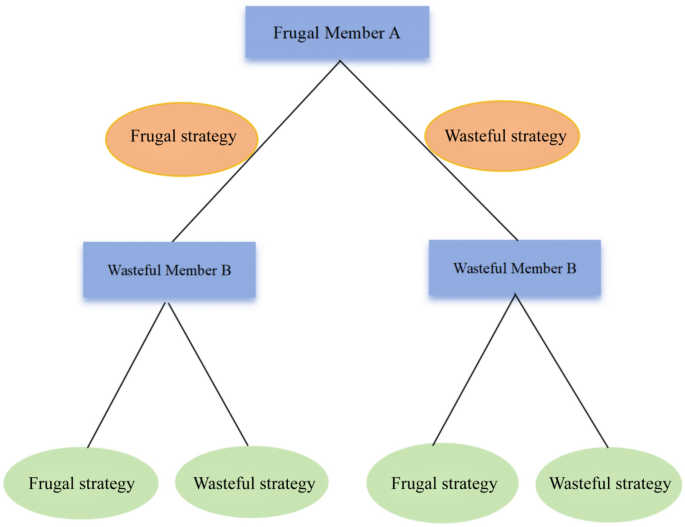
Based on the above research qualifications, the utility matrix of heterogeneous subjects under different combinations of strategies in shared living spaces is constructed (see Table 1 and Fig. 1).

Combination of strategy choices for both sides of the game.
Analysis of the interactive evolutionary process of heterogeneous subjects’ energy-using behavior
Analysis of the dynamics of replication of the subject
(1) Analysis of the replication dynamics of frugal member (A).
Based on the utility matrix of heterogeneous subjects under different combinations of strategies (see Table 1), the expected utility and the average expected utility of the member (A) of the energy-conserving behavior under different behavioral strategies are calculated separately.
A in choosing the expected utility \({E}_{{U}_{A1}}\) of strategy \({S}_{1}\):
$${E}_{{U}_{A1}}=y{U}_{A1}+(1-y){U}_{A1}{\prime}$$
(1)
A in choosing the expected utility \({E}_{{U}_{A2}}\) of strategy \({S}_{2}\):
$${E}_{{U}_{A2}}=y{U}_{A2}{\prime}+(1-y){U}_{A2}$$
(2)
The average expected utility \({E}_{{U}_{A}}\) of A:
$${E}_{{U}_{A}}=x{E}_{{U}_{A1}}+(1-x){E}_{{U}_{A2}}$$
(3)
Then the equation for the replication dynamics of A’s choice of economizing strategy is:
$$F(x)\hspace{0.17em}=\hspace{0.17em}\frac{dx}{dt}=x ({E}_{{U}_{A1}}-{E}_{{U}_{A}})\hspace{0.17em}=\hspace{0.17em}x (1-\text{x}) [y\left({U}_{A1}{-U}_{A2}^{\prime}-{U}_{A1}^{\prime}+{U}_{A2}\right)+{U}_{A1}^{\prime}-{U}_{A2}]$$
(4)
$${\text{F}}^{{{\prime}}}\left(x\right)= (1-2\text{x}) [y\left({U}_{A1}{-U}_{A2}^{{{\prime}}}-{U}_{A1}^{\prime}+{U}_{A2}\right)+{U}_{A1}^{{\prime}}-{U}_{A2}]$$
(5)
Let \(F(x)=\frac{dx}{dt}=\) 0, which can be solved by: \({x}_{1}=0, {x}_{2}=1,{ y}^{*}=\frac{{{U}_{A2}-U}_{A1}{\prime}}{{U}_{A1}{-U}_{A2}{\prime}-{U}_{A1}{\prime}+{U}_{A2}}\), according to the stability theorem of the replication dynamics equation, it can be seen that if x is made to be the evolutionarily stable strategy, the conditions that need to be satisfied are:\(F(x)=0,{\text{F}}{\prime}\left(x\right)<\) 0. Therefore, three stable states of the evolutionarily stable strategy of member A can be obtained:
When \({y}^{*}=\frac{{{U}_{A2}-U}_{A1}{\prime}}{{U}_{A1}{-U}_{A2}{\prime}-{U}_{A1}{\prime}+{U}_{A2}}\), \(F(x)=0\),\({\text{F}}^{\prime}\left(x\right)=0\), all x values are steady state; when \({y
(2) Dynamic equations for the replication of a member of the wasteful type (B).
Based on the utility matrices of the subjects of the two types of energy-using behaviors under different combinations of strategies (see Table 1), the expected utility and average expected utility of the members of the wasteful energy-using behaviors (B) under different behavioral strategies are calculated separately.
B in choosing the expected utility \({\text{E}}_{{\text{U}}_{\text{B}1}}\) of strategy \({\text{S}}_{1}\):
$${E}_{{U}_{B1}}=x{U}_{B1}+(1-x){U}_{B1}{\prime}$$
(6)
B in choosing the expected utility \({\text{E}}_{{\text{U}}_{\text{B}2}}\) of strategy \({\text{S}}_{2}\):
$${E}_{{U}_{B2}}=x{U}_{B2}{\prime}+(1-x){U}_{B2}$$
(7)
The average expected utility \({\text{E}}_{{\text{U}}_{\text{B}}}\) of B:
$${E}_{{U}_{B}}=y{E}_{{U}_{B1}}+(1-\text{y}){E}_{{U}_{B2}}$$
(8)
Then the equation for the replication dynamics of B’s choice of wasteful strategy is:
$$F(y)\hspace{0.17em}=\hspace{0.17em}\frac{dy}{dt}=y ({E}_{{U}_{B1}}-{E}_{{U}_{B}})\hspace{0.17em}=\hspace{0.17em}y (1-y)[ x\left({U}_{B1}-{U}_{B2}^{\prime}-{U}_{B1}^{\prime}+{U}_{B2}\right)+{U}_{B1}^{\prime}-{U}_{B2}]$$
(9)
Finding the first order derivative of F(y) yields:
$${\text{F}}^{\prime}\left(y\right)= (1-2y)[x\left({U}_{B1}-{U}_{B2}^{\prime}-{U}_{B1}^{\prime}+{U}_{B2}\right)+{U}_{B1}^{\prime}-{U}_{B2}]$$
(10)
Let \(F\left(y\right)=\frac{dy}{dt}=0\), can be solved by: \({y}_{1}=0\),\({y}_{2}=1\),\({x}^{*}=\frac{{{U}_{B2}-U}_{B1}^{\prime}}{{U}_{B1}-{U}_{B2}^{\prime}-{U}_{B1}^{\prime}+{U}_{B2}}\). According to the stability theorem of the replicated dynamic equations, it can be seen that if \(y\) is made to serve as an evolutionary stabilizing strategy, the conditions that need to be fulfilled are:\(F(y)=0\),\({\text{F}}^{\prime}\left(y\right)<0\). Therefore, the three stabilizing states of the evolutionary stabilizing strategy of mem-ber B can be obtained:
When \({x=x}^{*}=\frac{{{U}_{B2}-U}_{B1}^{\prime}}{{U}_{B1}-{U}_{B2}^{\prime}-{U}_{B1}^{\prime}+{U}_{B2}}\), \(F\left(y\right)=0\),\({\text{F}}^{\prime}\left(y\right)=0\), all \(y\) values are steady state; the existence of only two possible stable state points is \({y}_{1}=0\),\({y}_{2}=1\) when \({x
Equilibrium stability analysis of evolutionary processes
Let F(x) = 0, F(y) = 0, by solving the combination of replicated dynamic equations, it can be obtained that there exist a total of five local equilibrium points of this gaming system on the plane \(\text{R}=\{(\text{x},\text{y})|0\le \text{x}\le 1, 0\le \text{y}\le 1\}\), i.e., \({\text{E}}_{1}\)(0, 0)、\({\text{E}}_{2}\)(0, 1)、\({\text{E}}_{3}\)(1, 0)、\({\text{E}}_{4}\)(1, 1)、\({\text{E}}_{5}({x}^{*}, {y}^{*}\)), where, \({x}^{*}=\frac{{{U}_{B2}-U}_{B1}^{\prime}}{{U}_{B1}-{U}_{B2}^{\prime}-{U}_{B1}^{\prime}+{U}_{B2}},{y}^{*}=\frac{{{U}_{A2}-U}_{A1}{\prime}}{{U}_{A1}{-U}_{A2}{\prime}-{U}_{A1}{\prime}+{U}_{A2}}\).
Determining the evolutionarily stable strategy (ESS) of the whole system can be done by analyzing the determinant of the Jacobi matrix of this system and the positivity and negativity of its traces to determine whether the system is stable at the local equilibrium or not, therefore, taking the partial derivatives of x and y in the combination of replicated dynamical equations, respectively, yields the Jacobi matrix of the gaming system of members A and B, J.
$${\varvec{J}}=\left[\begin{array}{cc}(1-2x)[y\left({U}_{A1}{-U}_{A2}^{\prime}-{U}_{A1}^{\prime}+{U}_{A2}\right)+{U}_{A1}^{\prime}-{U}_{A2} ]& x(1-x)\left({U}_{A1}{-U}_{A2}^{\prime}-{U}_{A1}^{\prime}+{U}_{A2}\right)\\ y(1-y)\left({U}_{B1}-{U}_{B2}^{\prime}-{U}_{B1}^{\prime}+{U}_{B2}\right)& (1-2y)[x\left({U}_{B1}-{U}_{B2}^{\prime}-{U}_{B1}^{\prime}+{U}_{B2}\right)+{U}_{B1}^{\prime}-{U}_{B2}]\end{array}\right]$$
(11)
If a local equilibrium is an evolutionarily stable strategy (ESS) of a game system, then the determinant det(J) and the trajectory tr(J) of that local equilibrium must satisfy the conditions det(J) > 0 and tr(J) < 0. In particular, if that local equilibrium det(J) > 0 and tr(J) = 0, then that local equilibrium is a saddle point; if that local equilibrium det(J) < 0, tr(J) = 0, then the local equilibrium point is a center point. To determine the stability of these local equilibrium points, i.e., \({\text{E}}_{1}\)(0,0)、\({\text{E}}_{2}\)(0,1)、\({\text{E}}_{3}\)(1,0)、\({\text{E}}_{4}\)(1,1)、\({\text{E}}_{5}\)(\({x}^{*}\),\({y}^{*}\)), the corresponding determinant det(J) and trajectory tr(J) of each local equilibrium point need to be discussed further.
Scenario (1): \({{U}_{B2}>U}_{B1}^{\prime}, {U}_{B1}-{U}_{B2}^{\prime}-{U}_{B1}^{\prime}+{U}_{B2}>0,{U}_{B2}^{\prime}<{U}_{B1}\text{ and }\)\({{U}_{A2}>U}_{A1}{\prime}, {U}_{A1}{-U}_{A2}{\prime}-{U}_{A1}{\prime}+{U}_{A2}>0, {U}_{A2}^{\prime}<{U}_{A1}.\) In this scenario, the game system has two evolutionarily stable points, namely \({\text{E}}_{1}\)(0,0) and \({\text{E}}_{4}\) (1,1), i.e., (waste, waste)and (save, save). When the proportion of wasteful subjects among members A and B is relatively large, the game system will gradually converge to the stable point (0, 0). At this time, both members A and B choose the wasteful strategy. When the proportion of economical subjects among members A and B is relatively large, the game system will gradually converge to the stable point (1, 1). At this time, both members A and B choose the economical strategy. That is to say, in the shared living space, the initial scales of the group with economical energy—using behaviors and the group with wasteful energy—using behaviors determine the future evolution direction.
Scenario (2):\({{U}_{B2}>U}_{B1}^{\prime},{U}_{B1}-{U}_{B2}^{\prime}-{U}_{B1}^{\prime}+{U}_{B2}>0,{U}_{B2}^{\prime}<{U}_{B1}\text{ and }{{U}_{A2} \( {U}_{A1}{-U}_{A2}{\prime}-{U}_{A1}{\prime}+{U}_{A2}<0,{U}_{A2}{\prime}>{U}_{A1}.\) In this case, there is no evolutionary equilibrium point of the system under this condition. In a shared living space, when the utilities obtained by the two players in a game under different strategy combinations meet the conditions of Scenario 2, a series of guiding strategies should be adopted as much as possible to prompt the game system to evolve towards the stable equilibrium point (1, 1) that we expect to reach.
Scenario (3): \({{\text{U}}_{\text{B}2}<\text{U}}_{\text{B}1}^{\prime},{\text{U}}_{\text{B}1}-{\text{U}}_{\text{B}2}^{\prime}-{\text{U}}_{\text{B}1}^{\prime}+{\text{U}}_{\text{B}2}<0\text{ and }\), \({\text{U}}_{\text{B}2}^{\prime}>{\text{U}}_{\text{B}1}\text{ and} {{\text{U}}_{\text{A}2}>\text{U}}_{\text{A}1}^{\prime},\)\({\text{U}}_{\text{A}1}{-\text{U}}_{\text{A}2}^{\prime}-{\text{U}}_{\text{A}1}^{\prime}+{\text{U}}_{\text{A}2}>0{\text{U}}_{\text{A}2}^{\prime}<{\text{U}}_{\text{A}1}\). In this case, the evolution strategy of the game system is in a state of dynamic change and cannot reach the evolutionary stable equilibrium strategy.
Scenario (4): \({{U}_{B2}{U}_{B1}\text{ and }{{U}_{A2} \({U}_{A1}{-U}_{A2}{\prime}-{U}_{A1}{\prime}+{U}_{A2}<0, {U}_{A2}{\prime}>{U}_{A1}.\) In this case, The game system has only two evolutionarily stable points, namely \({\text{E}}_{2}\)(0,1) and \({\text{E}}_{3}\)(1,0), i.e., (waste, save)and (save, waste). At this stage, energy-saving and energy-wasting behaviors coexist: some individuals conserve energy due to policy incentives or habits, while others persist in wasting due to low costs or weak awareness, forming a dynamic equilibrium at the locally stable points (0,1) or (1,0).
link