Woodstock microHomes founder Rob Goldman has worked as a photographer for the past 40 years, creating images for publications such as Cosmopolitan, Time, Brides, and Mademoiselle. Although his roots are in photography, he has been in love with homebuilding and social action for as long as he can remember.
“As a child, I claimed that I’d be an architect when I grew up,” he recalls. “Although I never acted upon that goal directly, I have designed five homes and four photography studios.”
His interest in architecture and homebuilding inspired him to run an Airbnb. After doing extensive research, he and his wife opted to purchase a microhome and install it on their property. Goldman purchased his microhome from a company in China and, while it was being shipped, he contracted workers to build the concrete piers that would serve as the foundation and connect to a septic system, plumbing, and electricity.
Unfortunately, the week before the house was due to be delivered, the site that Goldman was planning for the microhome was deemed “unsuitable.” The only solution Goldman could think of was to list the home on Facebook Marketplace and try to sell it. That solution turned out to be the first promotion of what would later become Woodstock microHomes.
The home sold quickly, but Goldman had one month of free storage before the buyers were able to bring it to their location. It was during those 30 days that Goldman’s life changed.
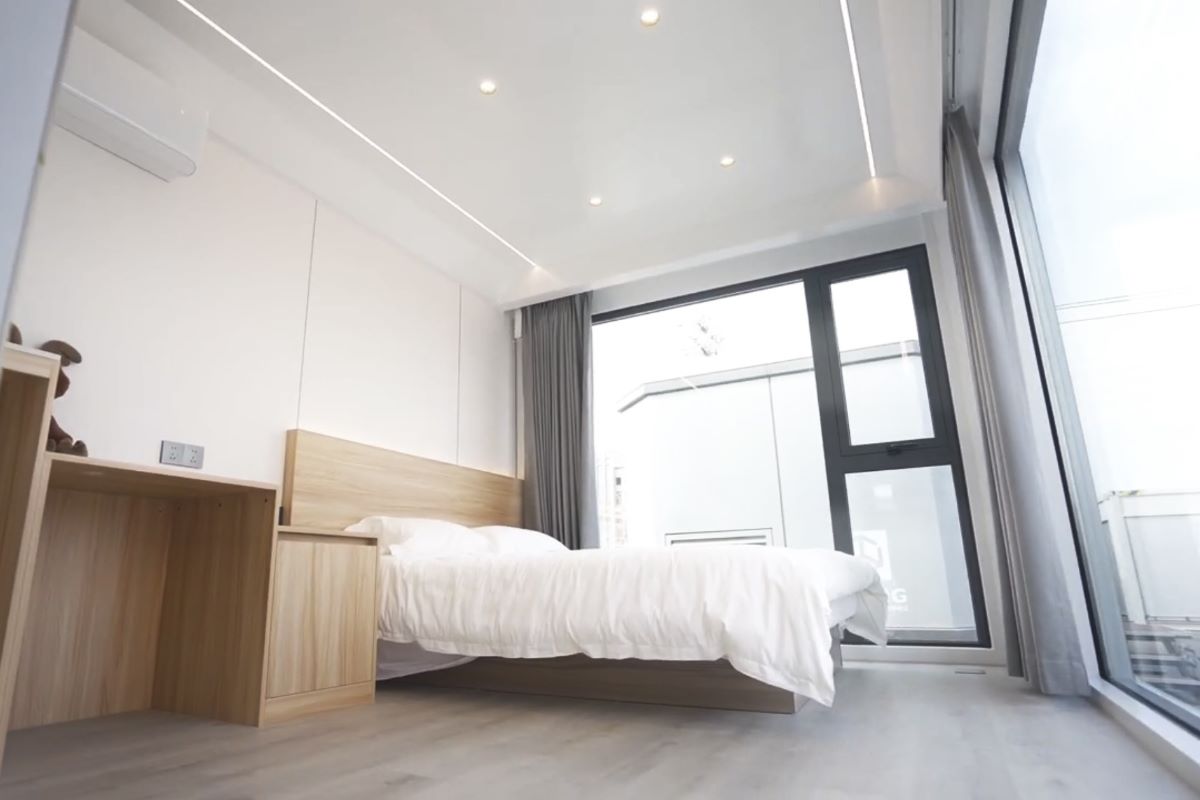
“Homeowners and personnel from the Ulster County Planning Department and the Rural Ulster Preservation Company (RUPCO) were amongst the many people who continued to swing by for a look,” he shares. “They saw it as a viable, affordable housing alternative, as well as an instant accessory dwelling unit. They were blown away from the combination of beautiful design, strength, and low cost. To be honest, so was I!”
Inside Woodstock microHomes
Woodstock microHomes do not involve any construction, which is one of the elements that first drew Goldman to them. “I imagined the number of people who could be helped quickly and easily,” he explains.
One of the key features of Woodstock microHomes is the modular architecture design. The entire house is broken down into individual modules, each with standard dimensions, and these modules are then connected using a unique system of latches and locks, making them easy to assemble or disassemble as needed.
The walls of Woodstock microHomes are constructed from aluminum-clad panels that come in various colors. Unlike traditional houses that require painting, these walls are pre-finished with the desired color, eliminating the need for additional costs and reducing waste.
One of the advantages of Woodstock microHomes is the transportation efficiency. The modules are designed to fit snugly into shipping containers, allowing for easy and cost-effective transportation to any location. Upon arrival, the installation of the microhome is as simple as screwing the modules together with a screwdriver.
Goldman notes that, in recent years, the world has seen a growing concern for environmental protection and sustainable living. Woodstock microHomes has emerged as a building solution.
“As technology continues to advance, Woodstock microHomes is poised to become a leading example of sustainable building practices. Its innovative design and efficient production process makes it an ideal solution for residential, commercial, and industrial projects alike,” he says. “By embracing this revolutionary building solution, we can create healthier, more energy-efficient, and environmentally responsible buildings that benefit both individuals and the planet.”
Woodstock microHomes in the Hudson Valley and Beyond
Although Woodstock microHomes has maintained a quiet year in the Hudson Valley, it’s had a lot going on behind the scenes.
Goldman swapped manufacturers in order to share the best homes and updated elements of the homes to be code compliant. “The good news is that we’re just about ready to unleash them! There are currently three finished Woodstock microHomes that have been installed in the Hudson Valley, and the best is yet to come!”
Goldman has also been importing microhomes to Costa Rica, where he and his family spend their winter months. “This has allowed me to work on building codes, learn about zoning, and widen my circle of contacts in the United States while selling them abroad.”
Next Steps
Goldman says that there is a tremendous amount in store for Woodstock microHomes. “For starters, Costa Rica is a proven market, and we plan significant distribution there in 2026.”
“We’re seeing distribution for affordable living, Airbnb hosts, and real estate developers throughout the northeastern United States,” he continues. “There is a definite need for the solution that we’re offering as so much land is being purchased without a building. In such cases, Woodstock microHomes offer the perfect solution as a temporary residence, and they can be easily moved and converted in a timely fashion.”
Currently, Goldman is looking for people in New York state who are interested in owning one or more homes, including developers, people committed to low-income housing, and, of course, individuals who would just like to own one.
To learn more about Woodstock microHomes, visit its website or contact the business at [email protected].
Related: That Creative Space Is a Communal Art Studio in Beacon
link